Showing posts with label horror. Show all posts

Wednesday, June 13, 2012

Two men who killed each other in the most honourable way possible - in prose.

I love the story of the relationship between Robert Block and H.P. Lovecraft: two men who killed each other in the most honourable way possible - in prose.

From the Reader's Almanac post, What Robert Bloch owes to H. P. Lovecraft:

One of the stories Bloch wrote while Lovecraft was alive featured Lovecraft as a character, killed by a monster. Weird Tales required Bloch to get the victim's permission before publishing the story, and Lovecraft authorized Bloch "to portray, murder, annihilate, disintegrate, transfigure, metamorphose, or otherwise manhandle the undersigned in the tale entitled THE SHAMBLER FROM THE STARS." In November 1935 Lovecraft responded in kind with "The Haunter of the Dark," in which young Robert Blake (living at Bloch's actual address) is killed by an alien. He dedicated the story to Bloch.

I got to searching this out by listening to Drabblecast 213 – The Haunter of the Dark. Drabblecast is about the most amazing podcast in the entire known Universe btw.

For the full text of the other piece featured on that Drabblecast episode, the poem Fungi from Yuggoth, see Fungi from Yuggoth on the H.P. Lovecraft site.

Tuesday, June 22, 2010

The Call of Cthulhu

H.P. Lovecraft's The Call of Cthulhu is available on WikiSource.

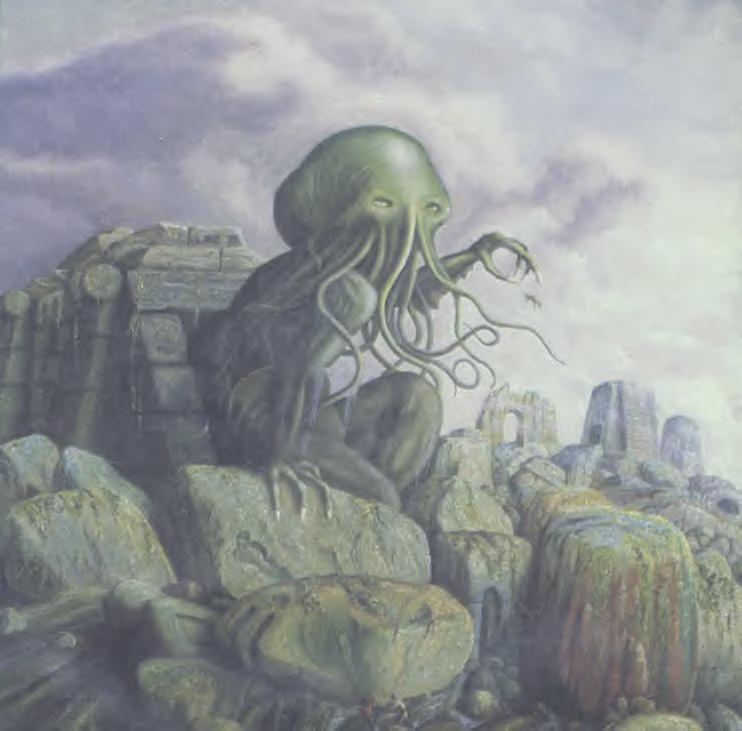
H.P. Lovecraft's Cthulhu horror is both powerful and inaccessible because it is visceral. Cthulhu is a monster of indescribable horror that is being described. We are used to monsters in films, books and pictures so we can conjure up images of foul beasts easily enough, but it is decidedly harder to adjust our mental image when Lovecraft writes that "The Thing cannot be described".

Thus, the essence of Cthulhu horror is emotional rather than visual. Lovecraft tries to evoke the sense that the monster and the reality it belongs to is so morbidly incomprehensible that just bearing witness to it will bring insanity and inevitable death! This notion is not friendly to intellectual inquiry: we understand "monster" as something concrete but the Cthulhu monster is imbued with a fear of something abstract.

I see this abstract horror in stories that leave things unexplained: in the movies Cloverfield and The Mist we never find out where the monsters came from, how they got here or what they wanted. What Lovecraft adds on top of that is a sense of incomprehension; like a person from a two dimensional universe trying to comprehend our three dimensional universe. In the 90's Sam Neill starred in what I think are two horror movies that are very close to Cthulhu horror: In the Mouth of Madness and Event Horizon. Both movies involve a somewhat hapless curiosity that descends into an incomprehensible, inescapable and abominable fate.

I enjoyed reading Call of Cthulhu because it was challenging to me; trying to comprehend what Lovecraft wanted to portray by writing a story about incomprehensible horror.

3.5 out of 5

Read this on my iPod Touch.

Tuesday, September 25, 2007

Sacrifice

Variant Frequencies hosts the story Sacrifice, written by Jason McDowell and narrated by Rick Stringer and Ali Groves.

It could almost be the story of what happened to Cole Sear when he grew up - the boy who could see dead people in M. Night Shyamalan's "The Sixth Sense". Their stories are different, but have much in common in all the right places.

"Unfortunately, the great Roman Catholic Church, for all its history of exorcisms and the like, is no longer much of a believer in the supernatural."

Our protagonist is Father Michael Brannigan, one of few who can see the spirit world. This story has a comfortable, steady build up, showing us Father Michael Brannigan's child hood, allowing us to understand that he is driven to help wherever he can. This is why he joined the church.

He was driven to go to those parts of the world where he might be most needed. He is a compassionate man, passionate about bringing peace - and Christ - to Zaire, Africa.
He will bring The Word to the natives.

"I learned the true meaning of "heathen". I learned why it is that God will allow no Gods before Him."

Father Michael Brannigan could see the spirits, and he could help them to the light, some of them anyway. Those who wanted the light.

"My second sin was lust."

Jason McDowell has crafted this tale well. The first part shows his boy hood, the second part shows his grasping for a manhood he always denied himself. In a heart-beat the third part turns from a leisurely pace to a thrilling dive where all sins are accounted for..

A thoroughly gripping story, with some inspired elements of Cthulu horror. I had to listen to this one twice to properly understand the ending, but it was well worth it. Easy 9 out of 10.

Sunday, June 24, 2007

Pseudopod: Were-wolf, President, Clint Eastwood, Nick Cave, Horror!

Just listened to Full Moon Over 1600, by Christopher Michael Cummings and read by Rick Stringer.

I thoroughly enjoyed this story! I didn't think I would at the start, when I realised it was focused on politics. However, I was hooked from the sentence "when a strange sensation crawls down his nose, into his throat"; this first hint that the President's lycanthropy had pushed him into a world of heightened senses. In other werewolf stories, those senses are used for hunting, fighting and generally eating people. In this story, it is what turns the President into a type of hero; and his eating people makes him a rather horrifying hero!

This is why I like "Full Moon Over 1600": in most stories I hear (fiction and non-fiction), presidents and were-wolves aren't usually good guys. In this story, becoming a were-wolf makes the president into a good guy! I enjoyed how Christopher Michael Cummings turned smell and intuition into a moral sense and it was amusing to find the "media spin" angle working for a good guy.

Perhaps most noticeable about this story is that it isn't just President as Were-wolf. Thanks to the voice of Rick Stringer, it was also Clint Eastwood as President and Werewolf!

There are questions in the Pseudopod forums about whether or not this a horror story. Thinking about this question was what led me to write this blog entry (and forum post).

I think it is a horror story. The were-wolf did some typical scary were-wolf things: i.e. eating people - but did so publicly, on camera, and it only increased his popularity! The contrasting figures of werewolf and president in this story were twisted together so that two common images appeared in one character in a disturbing way. This is what a good horror story should do: disturb the audience!

In a broader sense, the question isn't very important to me. Horror is visceral - therefore it is open to interpretation and different people will classify different things as being horrific. Someone thought it fit the genre, and I enjoyed the story with that in mind. Most of the time, that's all it takes for me. Even if I do find a "horror" story that I don't personally think is a horror story, I find value in the story just by wondering why we might be at odds; why that other person found it horrifying, even if I didn't.

A small side story. A friend once made a tape for me of Nick Cave's The Murder Ballads. Now that is one scary album! Each song creeped me out in a different way, with "O' Malley's Bar" being the song that burnt itself most strongly into my mind with a detailed portrayal of a twisted mind. This song was effective because the "detail" I mention came not just from the lyrics. It was Nick Cave's voice and the jarring melody that really gave me a sense of how insane the man was. I digress: the point being that this album was the most horrific music I had ever listened to (and I loved it!).. but at the end of the tape, my friend had included another song, "Into My Arms" from The Boatman's Call - an album of (ostensibly) love songs from Nick Cave that I had not heard about. The first verse:

I don't believe in an interventionist God
But I know, darling, that you do
But if I did I would kneel down and ask Him
Not to intervene when it came to you
Not to touch a hair on your head
To leave you as you are
And if He felt He had to direct you
Then direct you into my arms

After listening to a whole album of songs about twisted, murderous minds, this song fit perfectly! Even though I have the Boatman's Call on CD now and have enjoyed listening to it many times, I still think of "Into My Arms" as one of the most subtle and chilling works of horror ever!

Horror is visceral; if it feels like horror, it is horror; maybe not to other people. "Full Moon Over 1600" felt like a good horror to me.

Variant Frequencies: sci-fi, horror and fantasy podcast

While I was listening to an episode of Escape Pod yesterday I heard about a new podcast, and it is amazing! Unfortunately they only come up with about one a month, so it won't take me too long to catch up, but I will do so gladly!


Last Flight of the Esperanza

Fifteen ships left Earth in search of new places for humans to live. When the Esperanza 15 crashes, only one of the crew is left alive. How will she survive when she is the only human on an entire planet?

This story has sound effects: a sound-scape that intensified the level of imagery invoked by the narration of a magnificent forest world. I kept thinking of the forest as an ocean, and I enjoyed the contrast: slow moving creatures that could almost be translucent jelly fish with their long tendrils, and the height of the trees that felt like the depth of an ocean. Both images (forest and ocean) were imbued in my head with the same sense of age, alien and beauty.

Other themes I greatly enjoyed in this story were transmogrification, adaptation and acceptance - in that order I believe. :) For the protagonist of this story, it wasn't a matter of choice. But it got me thinking of another story I read years ago. "Waiting for the Rain" by Dirk Strasser (found Metaworlds - ISBN 0 14 023766 6). "Waiting for the Rain" is a very sad story with the same themes but in a different order: acceptance, transmogrification and adaptation.


First Born

This was a horror story, which to me seemed a blend of Omen (without the child) with a touch of Dogma (without the humour).

All the way through it, my sense of dread grew as I felt the inevitable conclusion draw me in. It was all in the voices, both written and spoken: the angels were all resigned, even at the start of the story. Resigned to the idea that there was no chance of redemption for anyone anymore, because the big G was gone; without evidence of a divine presence, time leached away their hope. It seemed even Raph was only continuing out of a sense of bloody mindedness.

I find this sense of resignation fascinating in vampire stories too: when they grow so old that they lose the ability to be interested in anything. When they become resigned to the idea that there is nothing worth .. un-living for anymore. In those stories it seems to me that it is fitting and right, because it shows that even their great evil can pass.

It this story, it is horrific - the wrong entities are giving up!

Perhaps the only sequel story to this should fall into the same vein as Louise Cooper’s Time-Master.. eventually, millennia from now, the pendulum will swing the other way.. Lu will be so bored of ‘ever lasting’ dominion that he will face his own sense of resignation…